Blog · maintenance
How Proper Attic Ventilation Prevents Ice Dams on Idaho Roofs
Ice dams are a ventilation problem, not just a winter problem. Learn how balanced intake and exhaust ventilation protects Nampa roofs through every freeze-thaw cycle.
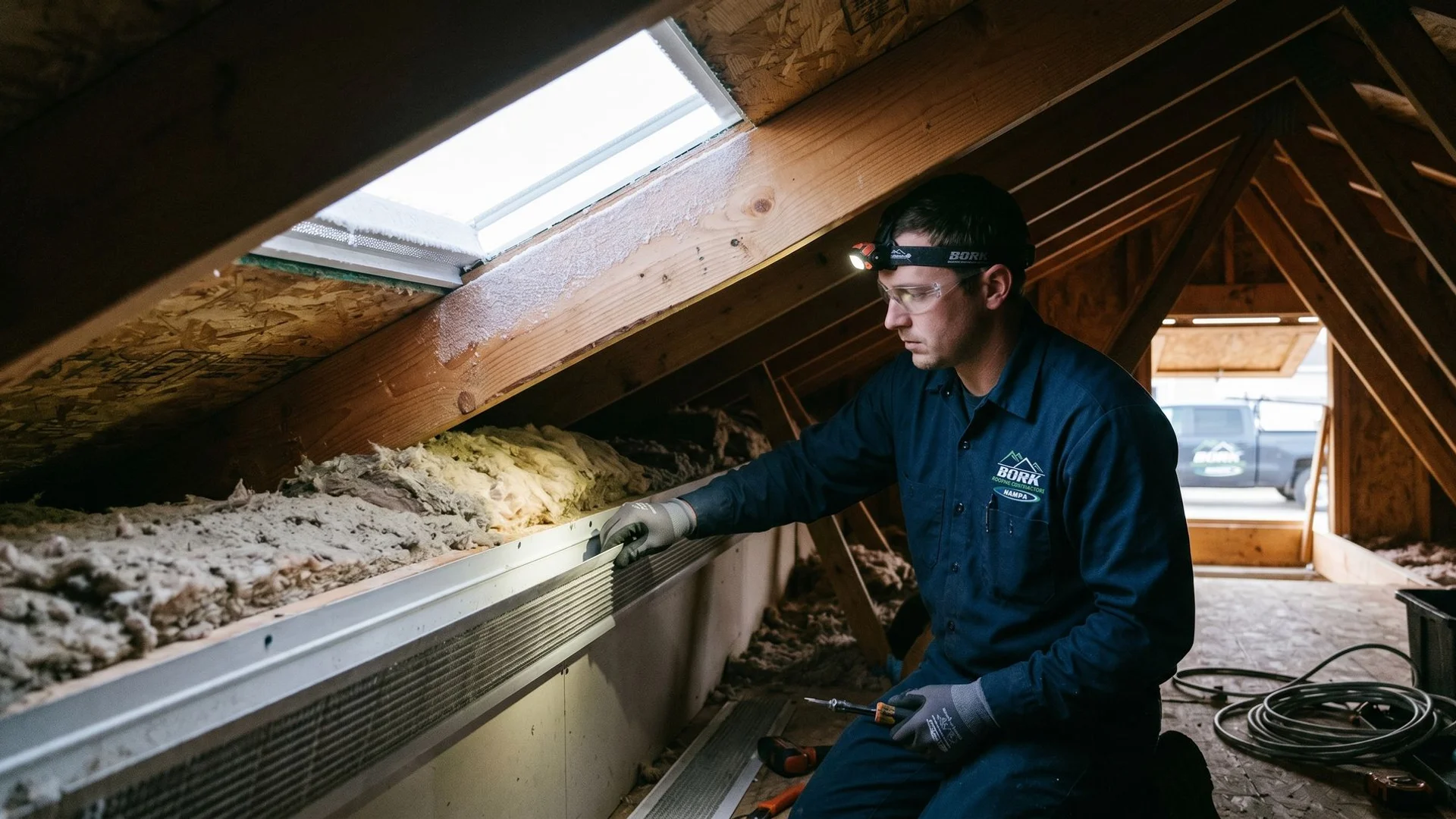
You know how frustrating it is to spot massive ice ridges on your property while the building next door looks perfectly clear. We see this exact scenario every winter across Canyon County. The dividing line between a clear roof and a costly leak is almost always attic ventilation.
Properly balanced intake and exhaust airflow — installed as part of a complete roof ventilation and insulation system — is the single most important factor in preventing ice dams. Our team of roofing professionals consistently finds that ventilation is the most overlooked component of standard roof replacements.
Let us look at the real data behind these winter leaks and explore a few practical ways to respond.
The Physics Of An Ice Dam
An ice dam forms when a specific set of conditions aligns on your property. We see this happen when three distinct environmental factors combine:
- Snow accumulation on the exterior shingles
- A localized warm spot on the interior roof deck
- A freezing zone positioned near the lower eaves
Heat escaping from your living space rises into the attic and warms the underside of the roof deck. Our daily inspections reveal that this trapped warmth melts the snow directly above it. The resulting liquid water flows down the slope until it hits the cold overhangs.
Since these extended eaves lack warm air underneath, the water quickly refreezes into a solid barrier. We watch this ice ridge grow thicker over several days until it blocks all downward drainage. Backed-up water eventually forces its way under the shingles and into the building.
According to 2026 industry data from Valley Peak Roofing, basic professional ice dam removal averages $1,200. If water breaches the interior, the average insurance claim hits $8,000 for property damage alone.
This whole destructive chain reaction starts with that isolated warm spot. We can eliminate that localized heating by establishing proper attic airflow.
What “Balanced” Ventilation Means
A properly ventilated attic relies on two equal halves of a continuous airflow system. We install intake vents at the lower eaves and exhaust vents at the highest peak. Cool outside air enters through the soffits and rises naturally as it warms inside the space.
Our installation crews rely on this thermal buoyancy to push heat and moisture out through the ridge. The intake area must roughly equal the exhaust area for the cycle to function correctly.
The Standard 1:300 Rule
The basic mathematical standard for this airflow is the 1:300 rule. We calculate 1 square foot of net free vent area for every 300 square feet of attic floor space. This total requirement is then split equally between the lower intake and the upper exhaust.
A standard 1,500 square foot attic requires 5 square feet of net free vent area in total. We would install 2.5 square feet of soffit venting and 2.5 square feet of ridge venting to achieve this balance.
Common Intake Failures in Nampa
Most older Nampa properties fall well below this required airflow standard. We frequently encounter houses constructed with absolutely no soffit openings. Many existing soffit vents are painted over, blocked by thick insulation, or improperly installed.
A 2025 analysis by the Building Science Corporation found that improper venting actually halves the effectiveness of your insulation in cold climates. We use these specific metrics to show property owners why partial fixes fail.
Why Ridge-Only Upgrades Fail
A common mistake in Treasure Valley construction is adding exhaust vents without verifying the lower intake. We constantly see ridge vents installed in isolation. Ridge products alone cannot push air out of the building.
Our teams explain that these top vents require soffit intake to actively pull outside air through the attic. Without balanced lower intake, a powerful ridge vent can actually draw conditioned air directly out of your living space. This vacuum effect pulls expensive heated air through ceiling light fixtures and plumbing penetrations.
We find this makes your winter heating bills significantly higher without solving the ice dam issue. Using a premium product like the Owens Corning VentSure Rigid Roll Ridge Vent is excellent, but it only works if the soffits are clear. This specific product passes rigorous snow infiltration tests at 70 miles per hour, yet we always assess both ends of the system together to guarantee those manufacturer specifications are met.
Comparing Ventilation Strategies
We use a simple comparison to illustrate the difference in system performance.
| Ventilation Strategy | How It Functions | Risk of Ice Dams | Energy Bill Impact |
|---|---|---|---|
| Ridge Vent Only | Acts as a vacuum pulling interior air | High risk | Increases heating costs |
| Soffit Vent Only | Traps rising heat near the roof peak | High risk | Traps summer heat |
| Balanced System | Creates a continuous natural draft | Low risk | Lowers monthly bills |
This is why you should never replace one component without measuring the other.
How To Tell If Your Ventilation Is Failing
Identifying poor airflow early can save you from catastrophic winter water damage. We look for specific physical indicators during our exterior and interior inspections. Catching these warning signs before a major Treasure Valley snowstorm is critical.
According to 2026 data from Weathershield Roofers, waiting until an ice dam causes a leak will cost between $500 and $2,000 just for the immediate shingle and membrane repairs. Our technicians evaluate the following warning signs:
- Ice dams forming in two or more recent winter seasons
- Visible snowmelt streaks appearing on one roof section but not another
- Frost coating the underside of the decking visible from inside the attic
- Unusually hot upstairs bedrooms during the summer months
- Premature shingle failure like curling or rapid aging
- Black or brown moisture staining on the interior wood
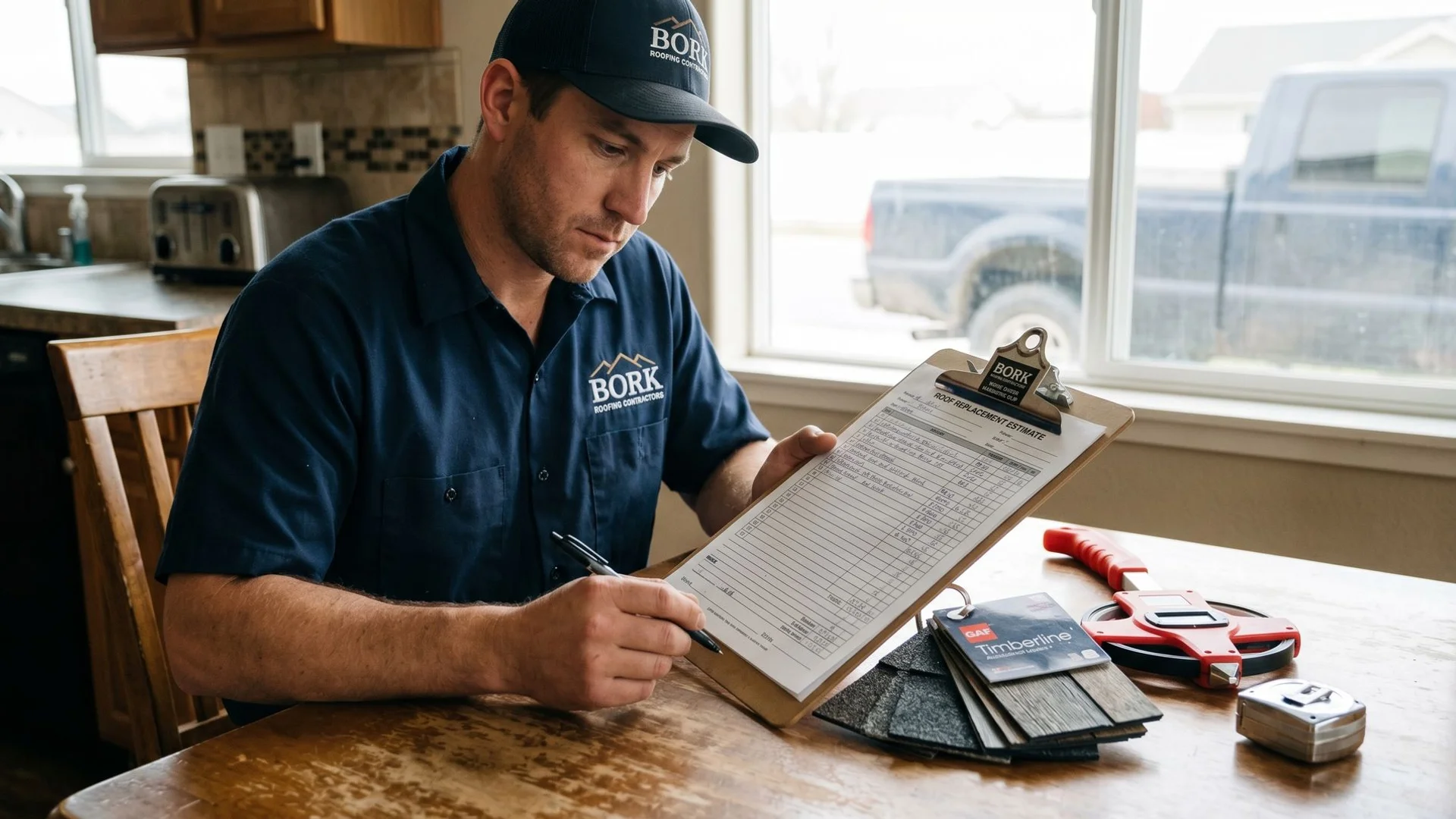
You should act quickly if you notice any of these distinct symptoms. We offer a complimentary 21-point Bork inspection to evaluate your property. This comprehensive process always includes a precise ventilation assessment.
What A Real Fix Looks Like
A complete system correction requires several coordinated steps to isolate the attic from the living space. We approach this as a comprehensive thermal and airflow upgrade. Done correctly, this combination drops attic temperatures dramatically and eliminates freezing ridges.
Our process also extends the lifespan of your shingles and reduces monthly utility costs. The right combination of repairs will keep your building dry for decades.
The 5-Step Correction Process
We follow a strict protocol to guarantee long-term performance.
- Air-seal the attic floor: This stops warm interior air from leaking upward at recessed lights, plumbing stacks, and electrical penetrations.
- Verify or install proper soffit intake: Retrofitting brand new vents is often required on older houses that never had them.
- Install a continuous ridge vent: We specify models with built-in baffles that prevent weather-driven precipitation from blowing back inward.
- Add thermal insulation: Upgrading the material thickness helps match current climate zone 5B recommendations.
- Install attic-floor baffles: We position these plastic chutes to keep the new blown-in materials from blocking the fresh soffit intake.
Taking Advantage of Local Incentives
Property owners in our area have a major financial advantage when completing these upgrades. We regularly help clients qualify for significant Idaho Power utility rebates. The 2026 Idaho Power program offers up to $0.35 per square foot for wall insulation upgrades and $0.20 per square foot for ceiling insulation.
Our administrative staff can guide you through the required rebate documentation. A 2025 U.S. Energy Information Administration survey showed that hitting the target R-49 to R-60 insulation range can trim your annual heating costs by 20 to 40 percent.
When To Schedule An Assessment
Protecting your property requires proactive maintenance before the freezing weather arrives. We highly recommend scheduling an attic ventilation and insulation assessment if you recognize any recurring issues.
- You have experienced freezing ridges in any of the last three winters.
- Your second floor remains significantly hotter or colder than the first floor.
- Your last roofing system failed years earlier than the manufacturer warranty predicted.
- Your monthly heating or cooling bills are noticeably higher than your neighbors.
- You spot visible frost or fuzzy mold growth on the interior wood framing.
This detailed evaluation is included free as part of our standard 21-point inspection process. Call (208) 606-3193 or request an inspection online. We are ready to secure your property against the harsh winter elements.
Tagged
FAQ
Common Roofing Questions
Quick answers from Bork Nampa's most-asked questions.
How much does a roof replacement cost in Nampa?
+
How long does a roof replacement take?
+
Does Bork Nampa help with insurance claims?
+
What is the best roofing material for Nampa's climate?
+
Do I need a permit for a roof replacement in Nampa?
+
My Nampa home was built before 1978. Does that matter for roof work?
+
How do I know if my Nampa roof needs repair or full replacement?
+
When is the best time to replace a roof in Nampa?
+
Who is the best roofing contractor in Nampa?
+
How do I prevent ice dams on my Nampa roof?
+
Is metal roofing worth the cost in Canyon County?
+
What warranties does Bork Nampa offer?
+
Do you provide roofing in Caldwell, Middleton, and Kuna?
+
Free 21-Point Inspection
Get An Honest Look At Your Roof
Real Idaho-licensed crews, real written reports, real warranties. Schedule your free inspection today.