Blog · maintenance
Why Is My Roof Leaking? Understanding Canyon County Ice Dams
Winter leaks in Nampa often start with ice dams, not bad shingles. Here is how Canyon County freeze-thaw cycles cause them and how to stop them.
You notice water dripping from the ceiling during a winter storm and assume you need an emergency roof repair.
That dripping water is usually the calling card of a deeply misunderstood winter failure.
Our team knows that Canyon County historically averages around 5.6 inches of snow in December alone. Why Is My Roof Leaking? Understanding Canyon County Ice Dams begins with looking past the surface. We will examine the actual data behind these leaks and walk through the exact permanent solutions to stop them.
What An Ice Dam Looks Like
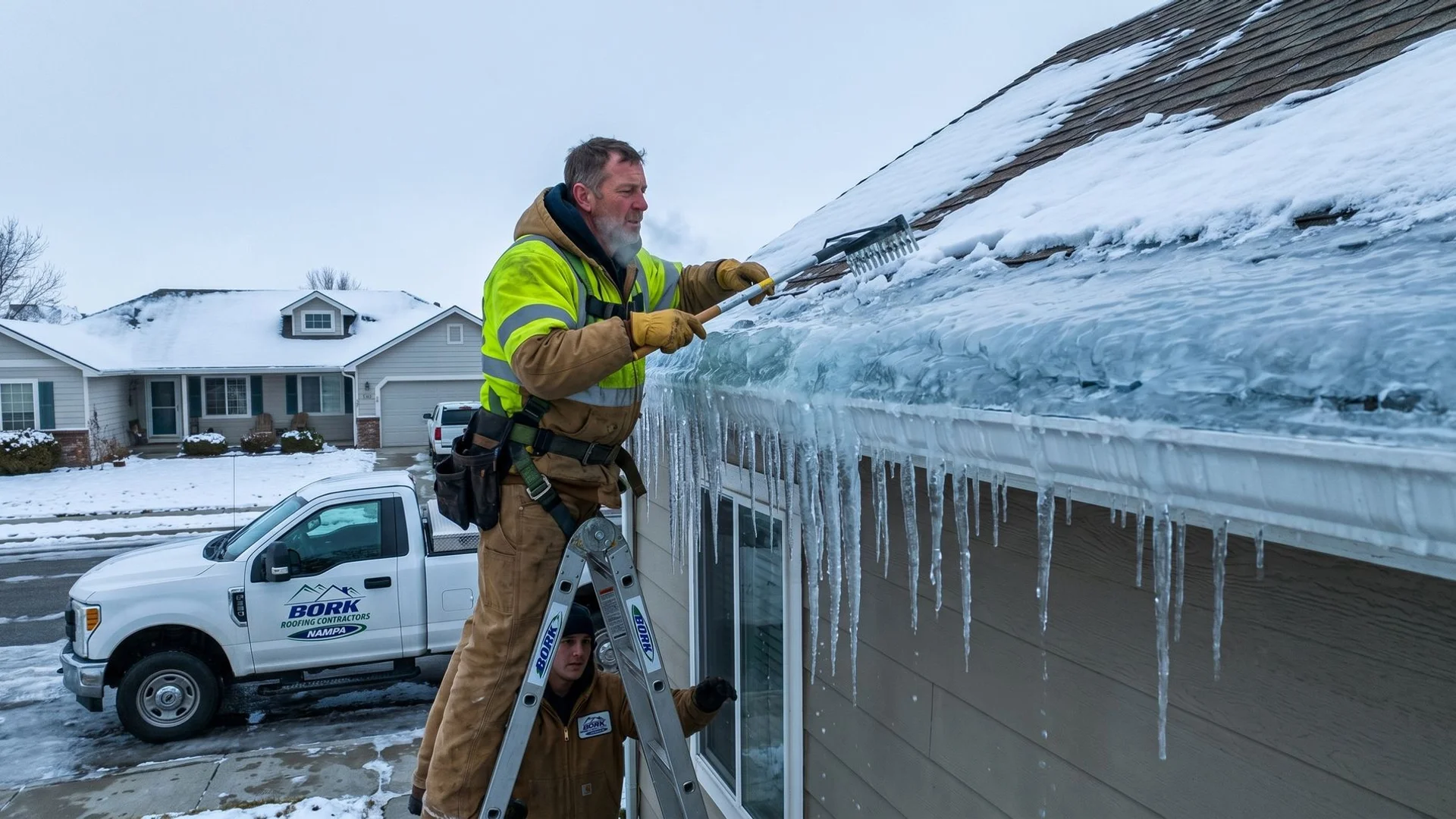
An ice dam is a thick ridge of frozen water that forms at the lower edge of your roof. You will usually spot it right above the gutters, often accompanied by a row of massive icicles.
Our crews frequently see homeowners underestimate the sheer physical weight of this buildup. Solid ice weighs approximately 57.2 pounds per cubic foot. That immense load places severe structural stress on the roof edges and gutter systems.
We find that the trapped melted snow pools backward because it has nowhere else to go. It backs up under the shingles, seeps through the underlayment, and eventually drains right into your attic.
The Root Cause: Heat Loss + Snow + Cold Eaves
Ice dams form when three specific conditions line up perfectly on your home. Our technicians always check for these primary triggers during winter inspections.
- Snow accumulation on the roof (Canyon County gets plenty every winter).
- A warm roof deck caused by heat escaping from your living space.
- Cold eaves that hang over the exterior walls and remain unheated.
Indoor heat warming the upper roof deck causes the initial melting process. The warm section melts the snow resting directly above it. We observe that this melted water flows down the slope until it reaches the cold eave.
At 32 degrees Fahrenheit, that water hits the freezing eave and hardens back into solid ice. As this cycle repeats over several days, the ice ridge grows thicker. Our experience shows that water eventually finds a nail hole or seam and drips into the house.
Why It Is A Ventilation Problem, Not A Shingle Problem
Why Is My Roof Leaking? Understanding Canyon County Ice Dams requires separating symptoms from the disease. Notice that the formation cycle has nothing to do with the quality of your asphalt shingles. We often remind clients that you can buy a brand-new $20,000 roof and still suffer water damage.
That core problem usually traces back to insufficient attic insulation. Heat from your living space escapes upward and artificially warms the decking. Our standard procedure involves checking compliance with the Idaho Energy Conservation Code.
This specific code requires a minimum of R-38 insulation for attics in Climate Zone 5. Poor attic ventilation also traps warm air inside instead of letting it escape outside. We know that a properly conditioned attic should stay very close to the outside air temperature year-round.
The Impact of Proper Temperature Balance
A well-ventilated roof deck stays uniformly cold throughout the winter. Snow either remains entirely frozen or melts evenly across the entire surface. Our installations guarantee this necessary thermal balance.
- Uniform freezing prevents the dam from starting in the first place.
- Even melting allows water to drain harmlessly into the gutters.
- Consistent temperatures protect the lifespan of your structural decking materials.
These simple physics principles dictate how your structure survives a heavy freeze. Ignoring them always leads to interior water damage.
The Wrong Fix: Patching Leaks
Most homeowners call with the exact same frustrating story after a winter storm. We hear how they paid another contractor to patch the leaking shingles, but the water returned the following year. That happens because patching the entry point ignores the actual disease.
Standard asphalt mastic sealant is essentially useless in freezing temperatures. Our industry data confirms that most sealants require an ambient temperature of at least 40 degrees Fahrenheit to activate their adhesive properties.
Applying cold patches in February is like putting a temporary bandage on a wound that never stops bleeding. It gives a false sense of security while the framing continues to rot.
The Right Fix: Address The Root Cause
A real, permanent solution involves a specific three-part approach to your attic space. We address the ventilation failure at the source.
- Air-Sealing: Block warm air from escaping upward through ceiling penetrations.
- Upgraded Insulation: Add high-quality insulation to hit modern R-49 to R-60 levels for maximum efficiency.
- Balanced Ventilation: Install continuous soffit intake and ridge exhaust.
Our final step requires following the International Residential Code standard known as the 1/300 rule. This strict code requires one square foot of net free ventilation area for every 300 square feet of attic space.
We also place specialized baffles to prevent the new, thicker insulation from blocking the required soffit vents. Once these steps are done correctly, the deck stays cold and ice dams stop forming.
Customers in Nampa and Caldwell frequently go from years of recurring leaks to zero issues after a single corrective project.
Emergency Heat Cable Is Not The Answer
Heat cables strung along the eaves can sometimes prevent water backup during a severe freeze. They are strictly a temporary measure, rather than a permanent structural solution. Our team warns that these cables do absolutely nothing to fix the costly heat loss occurring in your attic.
Local energy audits show exactly how expensive these temporary fixes become. A standard constant-wattage heating cable uses about 5 watts of electricity per foot. We calculate that running just 100 feet of cable constantly can easily add $40 to $60 to your monthly utility bill.
| Solution Method | Monthly Operating Cost | Solves Root Cause? | Lifespan |
|---|---|---|---|
| Heat Cables | $40 to $60 (Electricity) | No | 3 to 5 Years |
| Proper Insulation & Ventilation | $0 | Yes | 20+ Years |
The cables draw electricity continuously and will eventually fail from weather exposure. Paying higher heating bills while running an expensive roof heater is highly inefficient.
When To Call Us
Structural damage can happen fast when water breaches your home.
Our emergency lines are open at (208) 606-3193 if you notice any alarming warning signs this winter.
Watch closely for these specific issues during a storm cycle.
- Active interior leaking during a snowstorm or sudden thaw.
- Visible ice ridges or unusually heavy icicles hanging at the eaves.
- Water staining on your second-floor ceilings near exterior walls.
- High winter heating bills combined with drafty upper rooms.
A professional intervention stops the damage from spreading into your drywall and framing. We provide a free 21-point inspection that includes a thorough attic ventilation and insulation assessment.
The assessment identifies the true root cause and outlines a fix that solves the problem permanently. Mold can begin growing within 24 to 48 hours of water intrusion.
Our primary goal is to secure your property quickly and safely. Why Is My Roof Leaking? Understanding Canyon County Ice Dams means taking proactive steps before the next storm.
Reach out today so you can protect your property and enjoy a dry, stress-free winter.
Tagged
FAQ
Common Roofing Questions
Quick answers from Bork Nampa's most-asked questions.
How much does a roof replacement cost in Nampa?
+
How long does a roof replacement take?
+
Does Bork Nampa help with insurance claims?
+
What is the best roofing material for Nampa's climate?
+
Do I need a permit for a roof replacement in Nampa?
+
My Nampa home was built before 1978. Does that matter for roof work?
+
How do I know if my Nampa roof needs repair or full replacement?
+
When is the best time to replace a roof in Nampa?
+
Who is the best roofing contractor in Nampa?
+
How do I prevent ice dams on my Nampa roof?
+
Is metal roofing worth the cost in Canyon County?
+
What warranties does Bork Nampa offer?
+
Do you provide roofing in Caldwell, Middleton, and Kuna?
+
Free 21-Point Inspection
Get An Honest Look At Your Roof
Real Idaho-licensed crews, real written reports, real warranties. Schedule your free inspection today.